Shopper Behavior Modeling: How AI Learns What Customers Really Want
June 12, 2026

 Customer Results
What Is Shopper Behavior Modeling?
Shopper behavior modeling is the process of using AI to interpret customer actions across a session and across time to predict intent and preference. Instead of treating each visit in isolation, it builds a running picture of what a shopper cares about.
The inputs include:
- Click and view history
- Dwell time on product pages
- Search queries and refinements
- Add-to-cart and wishlist actions
- Purchase history
- Return and refund behavior
- Session context (device, time of day, referral source)
The output is a real-time understanding of what that shopper is trying to accomplish right now, and a longer-term profile of their preferences that improves every interaction over time.
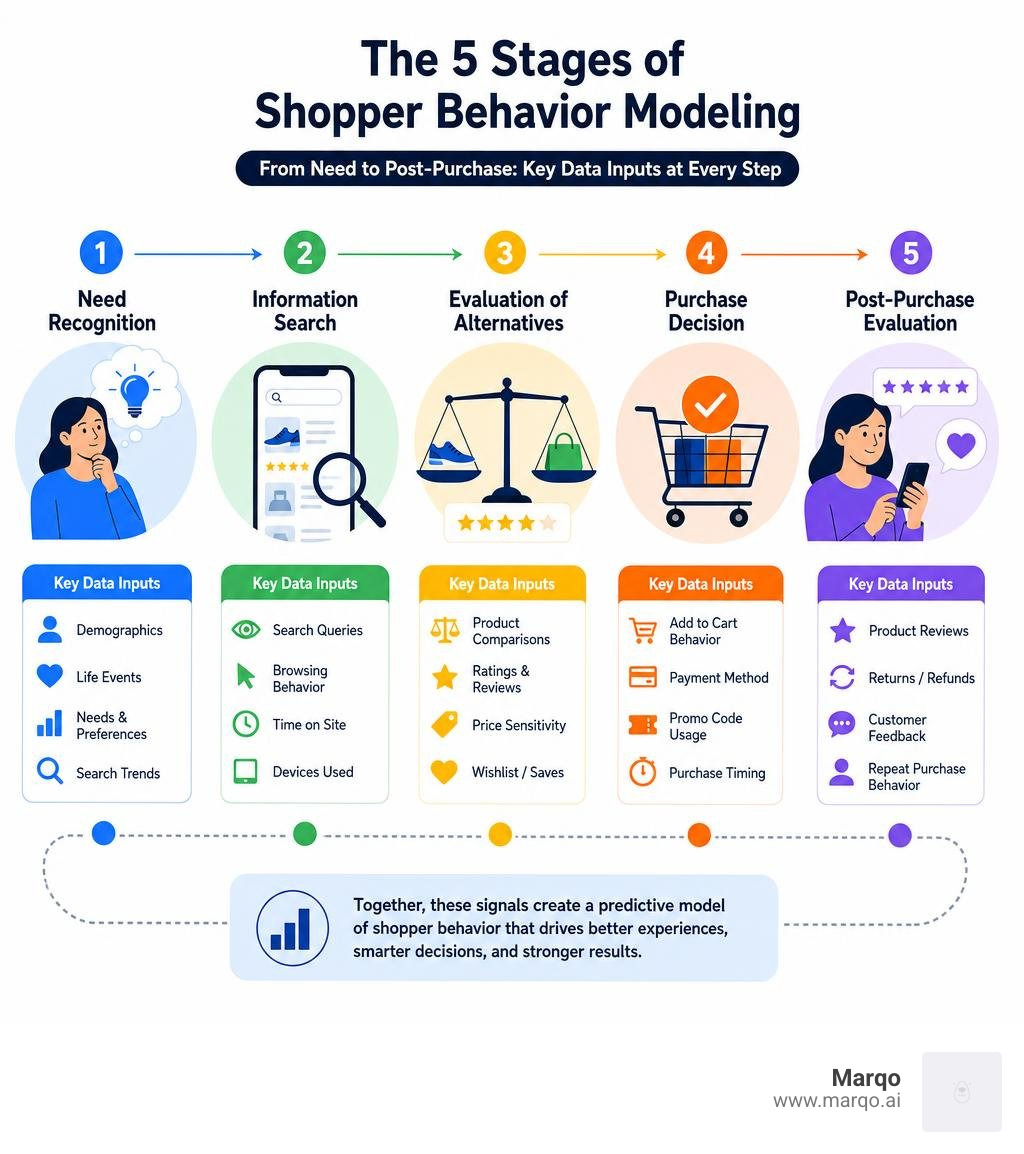
The Five Stages of Shopper Behavior
Understanding shopper behavior means recognizing that a customer moves through distinct stages, and the signals they generate at each stage mean something different.
1. Discovery
The shopper does not know exactly what they want yet. They are browsing broadly, exploring categories, using vague search terms. The right response is to surface variety and help them narrow down. A system that pushes bestsellers at this stage is likely to miss.
2. Consideration
The shopper has identified a need and is evaluating options. They are comparing products, reading descriptions, checking reviews. The signals here are longer dwell times, multiple views of similar items, and filter usage. The right response is to surface the attributes that matter most to them based on what they are engaging with.
3. Intent
The shopper is ready to buy but has not committed yet. They have added something to cart or are returning to a product page they visited before. The right response is to reduce friction and reinforce the decision they are already making.
4. Purchase
The transaction happens. This is a strong signal, but it is only the beginning of the relationship. What the shopper bought tells you something about them. How they shopped tells you more.
5. Post-Purchase
The shopper returns, exchanges, reviews, or does not come back. Post-purchase behavior is one of the most underused signals in ecommerce. A return tells you something went wrong in the matching process. A repeat visit within days tells you the experience worked.

Why Most Platforms Get This Wrong
The majority of ecommerce search and personalization platforms are built on the same foundation: collaborative filtering. They identify patterns across all users and surface products that similar users bought.
This works reasonably well when a catalog is small and customer segments are broad. It breaks down in three situations that are common to almost every growing retailer:
New products with no purchase history
If a product was added yesterday, collaborative filtering has nothing to work with. The product will not surface in recommendations until it accumulates enough transactions to register a pattern. For fashion, seasonal goods, and anything trend-driven, this lag is expensive.
New customers with no history
A first-time visitor gets generic results because the system has no data on them. The solution most platforms use is to fall back to popularity, which means every new customer sees the same thing. This is a missed opportunity at the most critical moment in the relationship.
Niche intent that does not map to mass patterns
If a shopper has specific, unusual preferences, collaborative filtering will pull them toward the center of the distribution, not toward what they actually want. The more distinctive a customer, the worse the system performs for them.
How AI-Native Behavior Modeling Works Differently
AI-native platforms approach this differently. Instead of relying on accumulated transaction history, they model behavior using the content of the products themselves alongside the signals a shopper generates in real time.
This is where embedding models become important. An embedding model converts a product, a search query, a category browse, or a session interaction into a shared numerical representation. Products that are conceptually similar end up close together in this space. When a shopper engages with certain products, their position in this space shifts toward those items and their neighbors.
The result is a system that can:
- Surface new products immediately, based on their content, without waiting for purchase history to accumulate
- Respond to a first-time visitor based on their in-session behavior, not just demographics
- Understand nuanced preferences that do not fit neat collaborative filtering buckets
- Update in real time as a shopper moves through a session

The Role of Catalog Intelligence
Shopper behavior modeling is only as good as the catalog understanding behind it. A system that cannot parse the difference between a dress shirt and a casual shirt, or between a road bike and a mountain bike, will draw wrong inferences from behavioral signals.
This is why catalog quality matters so much. When an AI model is trained on your specific catalog, it learns the language of your products. It understands which attributes matter in your category, how your products relate to each other, and what signals are meaningful versus noise.
Marqo trains a dedicated AI model on your catalog. This is not a generic model applied across all retailers. It is a model that has learned the structure and semantics of your specific product set, which means it draws more accurate inferences from the behavioral signals your shoppers generate.
Measuring the Impact
The metric most retailers use to measure search and discovery quality is revenue per session. A better behavioral model means more sessions end in purchase, more sessions end in the right purchase, and more customers return.
The leading indicator is usually click-through rate on recommendations and search results. When the model is working, shoppers click on things that match their intent. When it is not, they scroll past results and either refine their search or leave.
Other signals worth tracking:
- Zero-result search rate (a high rate means the model is not bridging between query language and catalog language)
- Add-to-cart rate from recommendations (measures whether recommended items are genuinely relevant)
- Return rate on AI-recommended products (a high return rate suggests the model is matching on surface attributes, not real preference)
What Commerce Superintelligence Looks Like in Practice
The retailers seeing the biggest gains are moving toward what we call commerce superintelligence: an AI layer that understands the full context of every shopper interaction and uses that understanding to drive every touchpoint, from search to recommendations to merchandising to promotions.
In practice, this means:
- A shopper who searched for running shoes three weeks ago sees different results for shoes today than one who searched for work shoes
- A new product launched this morning surfaces in relevant recommendations within hours, not weeks
- A shopper who returned a size medium gets smaller size options surfaced more prominently next time
- Category pages reorganize themselves based on what the current visitor has signaled they care about
None of this requires explicit signals from the shopper. It emerges from a model that has learned what behavioral patterns mean in the context of your catalog and your customers.
Getting Started
If you are evaluating where your current platform falls short, the clearest diagnostic is to look at your new product performance and your new visitor conversion rate. These two metrics expose whether your system is relying on historical data or actually modeling intent in real time.
A platform that struggles with both is one built on collaborative filtering alone. A platform that handles both well has genuine behavior modeling at its core.
If you want to see how Marqo approaches this, book a demo. We will walk through your specific catalog and show you what a dedicated AI model built on your data looks like in practice.
Shape Your Growth With AI-Native
Product Discovery
Transform product discovery with Marqo and get measurable ROI in 14 days, not months.